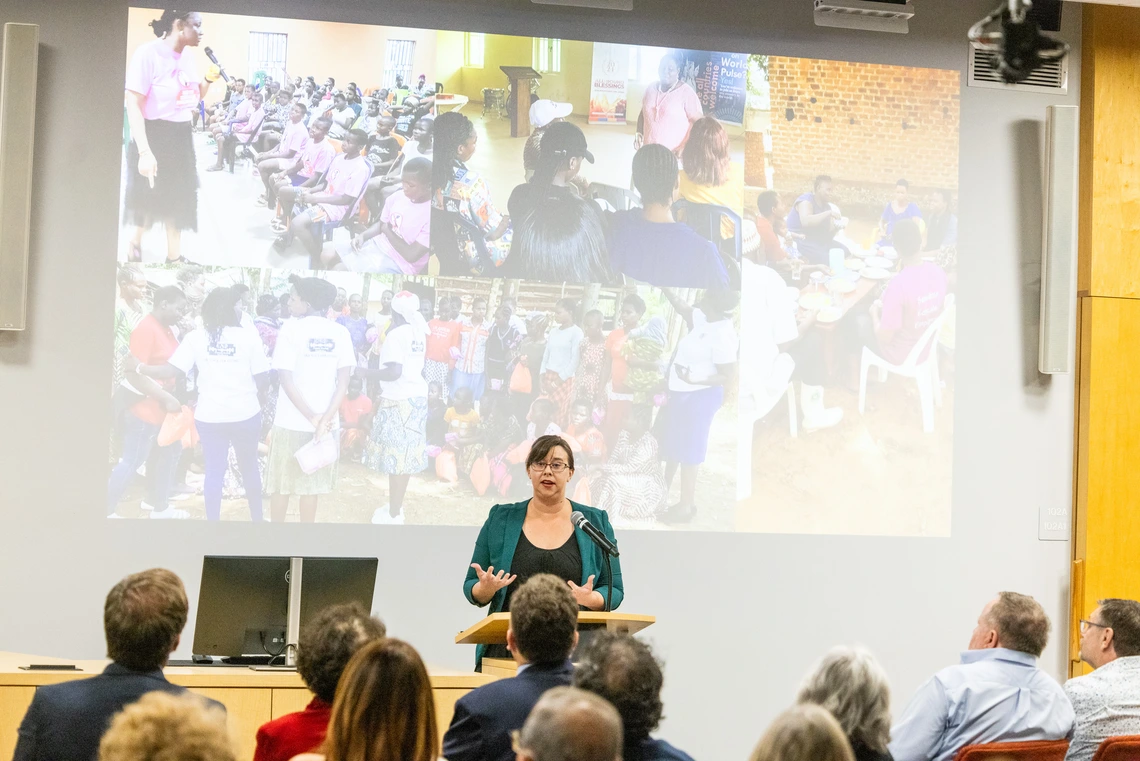
Assistant Professor Jasmine Linabary from the College of Humanities exuded a calm, soothing presence from the moment our meeting started. While this could also be partially a result of the happy exhaustion a new baby brings into one’s life, Dr. Linabary immediately considered my needs first, and ensured I could record our meeting. Of course, she is an experienced qualitative researcher and graduated with a degree in Journalism, so this is probably second nature, but it quickly established an environment of compassion and care.
This attentiveness reflects the core of Dr. Linabary’s mentoring philosophy. Dr. Linabary leads by example rather than authority, creating spaces where ideas flow freely and every voice carries weight. To her, mentoring is not about directing others but about learning alongside them. Driven by equity and inclusion, Dr. Linabary sees herself as both teacher and learner, continually refining her practice through reflection and feedback. She listens to her students, concerned with what they are missing from their classes. Through her lab, she helps ensure undergraduates are able to practice the skills they feel they are lacking from classwork.
Dr. Linabary credits her own transformative undergraduate research experience for shaping her academic path. She earned her undergraduate degree in Journalism and Mass Communication and, coming from a family with no history of graduate education, hadn’t initially considered pursuing advanced study. Experiencing imposter syndrome, she didn’t view graduate school as a possibility until a semester-long research project changed her trajectory. The depth of that project, and the encouragement of her faculty mentor, set her on the path that led to her Ph.D. in Communication, as well as to her enduring passion for mentoring and research.
Today, her VIP team, Co-Design Collaborative (Co-Lab), works across disciplinary boundaries to rethink how people and organizations come together to address enduring and emerging challenges in their communities, such as peacebuilding, food justice, and inequity. Guided by Dr. Linabary’s mentorship, Undergraduate Research Ambassador Henry Wilkerson has adopted research that empowers both students and communities to become knowledge producers. His journey in the Co-Lab illustrates how immersive, interdisciplinary research experiences can transform not just academic paths, but entire worldviews. Through this work, Henry has contributed alongside the Co-Lab and partners at World Pulse on a public report about shifting power in the international development sector and has become a co-author on an academic manuscript.
Dr. Linabary’s work exemplifies how thoughtful, inclusive mentorship can transform both individuals and communities. Through her commitment to collaborative learning, she not only empowers students to see themselves as researchers and changemakers but also models a leadership style grounded in empathy, curiosity, and reflection. Her approach reminds us that the most meaningful scholarship emerges not from hierarchy, but from shared purpose, a lesson she continues to pass on to every student who joins her in the pursuit of understanding and social impact.